
Global Capability Center
A Global Capability Centre (GCC) is a captive offshore entity set up by a multinational company in a cost-effective, talent-rich location to deliver a wide range of business functions — including technology, analytics, finance & accounting, legal, HR, and more — exclusively for the parent organisation. Unlike outsourcing, a GCC is wholly owned and controlled by the parent company, giving it full visibility, governance, and strategic alignment.
GCCs have evolved from simple cost-saving centres to strategic value hubs. Key drivers of their growing popularity include:
• Access to a large, skilled, diverse talent pool
• Significant cost arbitrage (30–50% savings vs. home country costs)
• Time zone advantages enabling round-the-clock operations
• Growing focus on digital transformation, AI, and analytics
• Improved global connectivity and remote work infrastructure
• India's strong regulatory and IP protection framework
While countries like Poland, Philippines, Mexico, and UAE are popular GCC destinations, India remains the undisputed leader, accounting for over 50% of all GCCs globally. India's advantages include:
• A talent pool of over 2.5 million STEM graduates annually
• Mature ecosystem in cities like Bengaluru, Hyderabad, Pune, Chennai, Mumbai, and Delhi-NCR
• Competitive cost structures
• Strong legal, accounting, and compliance frameworks
• Government incentives and a pro-business policy environment
• Proven track record across BFSI, technology, healthcare, and manufacturing sectors
Modern GCCs are no longer limited to back-office work. They can manage:
• Technology & IT – Software development, cybersecurity, cloud services, ERP support
• Data & Analytics – Business intelligence, AI/ML, data engineering
• Customer Support – Client servicing, CRM, technical helpdesk
• Finance & Accounting – Record-to-Report, Procure-to-Pay, Order-to-Cash
• Legal & Contracts – Contract management, legal research, regulatory compliance
• HR & Payroll – Talent acquisition, payroll processing, L&D
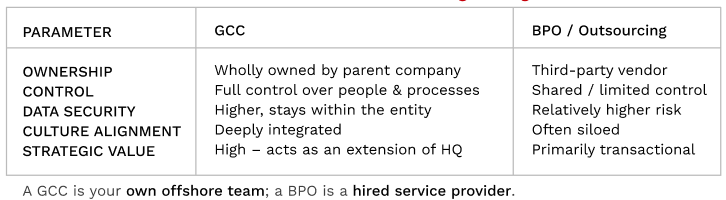
A GCC in India can be established through the following structures, each with distinct regulatory implications:
• Private Limited Company , Limited Liability Partnership (LLP), Branch Office ,Liaison Office for Customer Support – Client servicing, CRM, technical helpdesk
For most GCCs, a Private Limited Company is the preferred and most practical structure due to its corporate governance flexibility and favourable treatment under Indian FDI regulations.
Setting up a GCC in India involves navigating multiple regulatory frameworks:
• Company Law – Incorporation under the -Companies Act, 2013
• Foreign Exchange – Compliance with FEMA, 1999 for FDI inflows and outflows
• Taxation – Registration under Income Tax, GST, and applicable state laws
• Transfer Pricing – Arm's length pricing for all intercompany transactions
• Labour Laws – Shops & Establishments Act, PF, ESI, Gratuity, and applicable state labour regulations
• SEZ / STPI Registration – If availing export benefits and tax exemptions
- Data Protection – Compliance with India's Digital Personal Data Protection Act, 2023
Transfer Pricing (TP) refers to the pricing of transactions — services, goods, IP, or financing — between related parties across different countries. For a GCC, every service delivered to the parent company is an intercompany transaction that must be priced at arm's length (i.e., as if it were between unrelated parties).
Non-compliance or incorrect TP documentation can result in:
• Significant tax adjustments and penalties
• Double taxation risks
• Disputes with tax authorities in India and the home country
Robust TP documentation, benchmarking studies, and an Advance Pricing Agreement (APA) strategy are essential for every GCC.
Yes. Depending on location and structure, GCCs can benefit from:
• SEZ (Special Economic Zone) – Tax holidays on export income (subject to MAT / AMT)
• STPI (Software Technology Parks of India) – Infrastructure support and procedural facilitation
• State-level Incentives – Subsidies on stamp duty, power, and lease rentals offered by various state governments
• Patent Box Regime – Reduced tax rates on income from patents developed in India
KGS can help you evaluate the most tax-efficient structure tailored to your business model and home country tax treaty position.
GCCs can be structured in multiple ways depending on your organisation's size, risk appetite, and long-term goals:
• Captive GCC – Fully owned and operated by the parent company, offering complete control over people, processes, and data.
• Build-Operate-Transfer (BOT) – A third-party expert builds and runs the GCC before transferring full ownership to the parent at an agreed milestone.
• Hybrid / Virtual GCC – Strategic functions are run captively while non-core activities are outsourced to specialist service partners.
• Managed GCC – Parent owns the entity but delegates day-to-day operations to a managed services partner.
• Joint Venture GCC – GCC is co-owned with a local or global partner, sharing resources, risks, and market knowledge.
Not sure which model suits you best? KGS can help you evaluate and choose the right GCC model and implement that for your business. Connect with our team today.
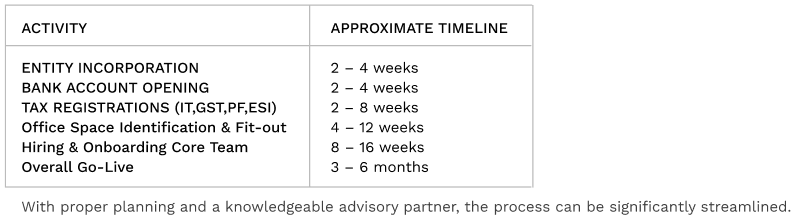
A GCC operates at the intersection of two or more regulatory jurisdictions, making its finance and accounting function uniquely complex. It needs to simultaneously:
• Maintain books under Indian GAAP / Ind AS
• Report to the parent in IFRS, US GAAP, or other local GAAP
• Comply with Indian tax laws (Income Tax, GST, TDS)
• Meet home country statutory and management reporting requirements
• Manage intercompany accounting and reconciliations
• Ensure cost allocation and recharge mechanisms are defensible under TP rules
This dual-jurisdiction complexity makes specialised F&A support from an experienced CA firm not just helpful, but essential.
An intercompany agreement (ICA) is the foundational legal and commercial document that governs the relationship between the GCC and its parent entity. It defines:
• Scope of services to be rendered
• Pricing methodology (cost-plus, markup percentage, etc.)
• Billing and payment terms
• IP ownership and licensing arrangements
• Confidentiality and data protection obligations
• Dispute resolution mechanisms
A well-drafted ICA aligned with both Indian law and OECD Transfer Pricing guidelines is critical to protecting the GCC's tax and regulatory position.
Effective GCC governance involves multiple layers:
• Board-level Oversight – Ensuring Indian entity compliance with Companies Act requirements (Board meetings, statutory filings, etc.)
• Operational Governance – SLAs, KPIs, and performance dashboards aligned with parent expectations
• Financial Governance – Budgeting, forecasting, cost centre management, and financial reporting
• Risk & Compliance – Internal audits, regulatory compliance calendar, and risk registers
• Data & IT Governance – Cybersecurity policies, data localisation requirements, and system access controls
KGS can help design and implement a governance framework that gives your parent company confidence while ensuring full local compliance.
India has a layered and state-specific employment law framework. GCC payroll compliance involves:
• Monthly payroll processing with accurate TDS computation
• Provident Fund (PF) contributions and EPFO filings
• Employee State Insurance (ESI) compliance
• Professional Tax as per applicable state laws
• Gratuity and Leave Encashment provisioning
• Annual filings – Form 24Q, Form 16 issuance
• Compliance with the New Labour Codes
• Errors in payroll compliance can attract penalties and create employee relations issues. KGS provides end-to-end payroll management designed specifically for GCC environments.
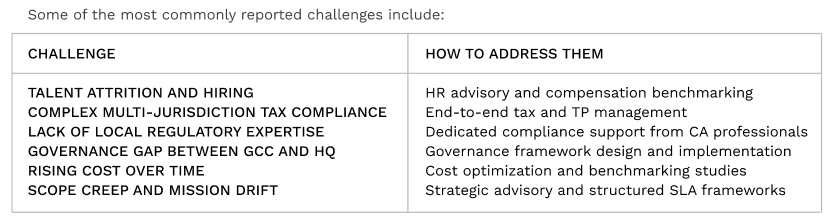
KGS offers a differentiated value proposition that complements or competes favourably with larger firms:
• Deep specialisation in Indian taxation, regulatory, and accounting matters
• Personalised attention – you deal directly with senior partners, not junior staff
• Alliance strength – access to a network of CA firms with pan-India geographic coverage
• Cost-effective – high-quality services at a fraction of Big-4 fee structures
• Agility – faster turnaround and decision-making
• Long-term partnership mindset vs. transactional engagement
• Sector experience across BFSI, technology, manufacturing, healthcare, and professional services
For GCCs — where local expertise, responsiveness, and trust matter enormously — KGS is the ideal partner.
Absolutely. As an Alliance of Chartered Accountancy firms, KGS has presence and partner network coverage across major GCC hubs in India, including Bengaluru, Hyderabad, Pune, Chennai, Mumbai, Delhi-NCR, Ahmedabad, Gurugram, Noida and etc
This pan-India presence ensures consistent, coordinated service delivery regardless of where your GCC is located.